
You have surely wondered what it’s like to be wealthy, or how one becomes wealthy. You may want to learn more about managing money, but aren’t sure where to look for information. Well, in this article, I will present key insights from the book The Psychology of Money by Morgan Housel. This book has captured the attention of many readers interested in finance, and it even won the “Best in Business Award” from the Society of American Business Editors and Writers.
Through this reading, I learned that people relate to money in different ways, depending on the social and economic category to which they belong. Those who grew up during a period of rising inflation manage their savings differently than those who grew up during a time of stable inflation. Many of us believe that money is earned according to mathematical rules, when, in fact, we acquire it because of the environment into which we were born and a bit of good luck.
Here are the ideas I’ve extracted from the book, along with the corresponding explanations!
Morgan Housel highlights that soft skills are more important than the technical side of money. He believes that people learn about money more through laws and rules than by engaging with emotions.
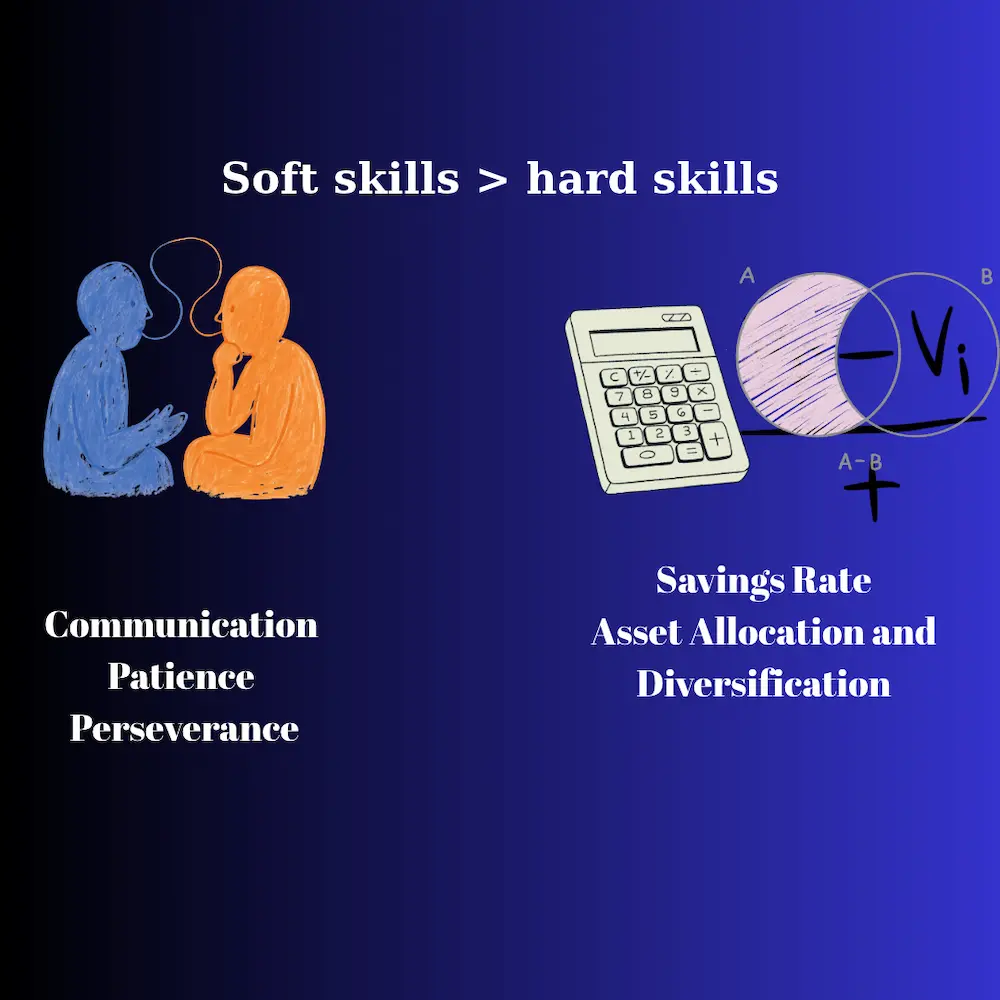
Key ideas, in brief
- People think they know how the world works, yet they have experienced only a small part of it.
- Not all successful people have worked hard, just as not all poor people have ended up in poverty due to laziness.
- There are things in life for which it is not worth risking everything, driven solely by a desire for wealth.
- Money should not be saved merely for security or consumption.
- True wealth is invisible.
- Economic opportunity arises from crisis.
Morgan Housel has been writing about the field of finance since the onset of the 2008 financial crisis. One of the primary lessons he learned in the aftermath is that no single person can explain the crisis’s emergence; furthermore, no one can state with precision why it occurred or what the appropriate course of action should have been. Following an extensive period of study, the author argues that an economic depression can be understood through the lenses of history and psychology—certainly not through finance alone.
To understand why people fall deep into debt, you must understand the history of greed, optimism, and insecurity—rather than just learning about interest rates.
No one is crazy
People have different opinions about how money works, and these opinions stem from their own life experiences. Those who have experienced poverty think about risk and reward differently than those who have experienced wealth.
Most of the time, how people understand finance has more to do with their personal experiences and where they have lived than with their level of education. For instance, in Japan and Germany, local stock markets were devastated during the Second World War—in contrast to the U.S., where the stock market doubled between 1941 and 1945, leading the country to become the strongest economy of the following two decades.
Luck and risk
Morgan Housel writes a letter to his son in which he says, “Just realize that not all success is due to hard work, and not all poverty is due to laziness. Keep this in mind when you judge people—including yourself.”
Never enough
We must avoid risking what we possess and what we need for the sake of what we do not possess and do not need. The new capitalism is adept at generating both wealth and envy. This implies that people desire to acquire more because they compare themselves to others, coveting their success.
Family, friends, freedom, independence, reputation, and happiness are things not worth risking in life.
Complication through accumulation
There are many notable figures who have excelled in the financial sector, and Warren Buffett is the prime example. More than 2,000 books have been written describing how Warren Buffett became wealthy—and while these books are excellent, Morgan Housel argues that they are missing something: specifically, the fact that Buffett amassed a vast fortune because he knew how to invest from the time he was a child. At the time this book was written, Buffett’s net worth stood at $84.5 billion.
Of this $84.5 billion total, only $84.2 billion reached his account after he turned 50—essentially, after five decades of life. Buffett began taking investing seriously at just 10 years old, and by the age of 30, he already had a net worth of $1 million—or $9.3 million when adjusted for inflation. Thus, time and patience are his secrets.
Becoming rich versus staying rich
To remain wealthy, you need to combine frugality with paranoia. To acquire wealth, you must take risks and be optimistic; however, to keep your wealth, you need to be humble and harbor a fear that everything you have built could vanish quickly. Survival is the foundation of your strategy when it comes to investments or business. Buffett managed to survive because he invested consistently over many years.
When making savings plans, you must consider every potential risk. A financial crisis could arise, inflation might occur, or any number of other issues could emerge. In economics, this is known as a “margin of safety.” This margin increases the likelihood of success at a given level of risk by boosting the chances of survival. Consider engineers who design bridges: they build them to withstand a load far greater than what is normally anticipated, thereby creating a buffer for error in the event of unforeseen circumstances. The same applies to business—you must account for the unexpected.
Thus, we can see that people tend to save money for unforeseen events at a micro level—for instance, if a household appliance breaks down, if they fall ill, or if they find themselves unable to pay a bill. However, they often fail to consider more serious, macro-level scenarios, such as a virus (like the Coronavirus), a real estate or financial crisis, or the loss of one’s job due to automation.
If it comes up tails, you win
When it comes to investments, no one makes good decisions all the time. People can create amazing things from terrible ideas, simply because they have the courage to put them into action. The point is that some famous business figures only achieved success with their products after experiencing numerous failures and launching offerings that didn’t work out. In 2013, at the Berkshire Hathaway shareholders’ meeting, Warren Buffett stated that he had held between 400 and 500 stocks throughout his lifetime, yet he made the bulk of his wealth from just 10 of them.
Money should provide control over time
The ability to do what you want, when you want, with whomever you want, for as long as you want, is priceless. It is the greatest dividend that money pays. A dividend is a portion of a company’s profit—essentially, your reward. The greatest reward that money can bring is not material possessions, but peace of mind and control over your time. Money should provide control over your time.
The Paradox of the Man in the Car
People use your wealth as a reference point for their own aspiration to be perceived in a positive light. In other words, if you own an expensive car, people who see it on the street aren’t thinking about you—or about how cool or wealthy you are—but rather about what it would be like for them to own that same car, and about the admiration and respect they would receive from others.
If you wish to gain admiration and respect based on your wealth, you will not achieve this through material possessions, but rather through kindness, humility, and empathy. These are the path to earning respect.
Wealth is not visible
There are people who have achieved only mediocre success and who have spent their entire salary—or all their accumulated savings—on expensive items, just to appear wealthy.
Wealth is unspent income. If you buy a car for 100,000 euros, you end up with the asset, but you are 100,000 euros poorer in your bank account. Granted, material possessions do bring us happiness, but there is a vast difference between someone who can afford an expensive car without it leaving a hole in their pocket, and someone who spends nearly all their money on a vehicle just to appear wealthy. The latter mimics the rich, yet fails to consider the actual amount of money that truly wealthy people hold in their bank accounts or investment portfolios.
Keep the money
You might wonder: if wealth means not spending money, what’s the point? Well, there is a point—provided you know how to save. You can save by spending less, and you end up spending less because you no longer desire things simply to appear wealthier to others. Truly wealthy people do not concern themselves with what others think of them.
The author further argues that wealth is linked more to one’s savings rate than to investment income. Savings grant you control over your time, enabling you to change career paths, retire early, and so on. When you lack control over your time, you run the risk of having to accept poor or unfortunate options—simply because you need the money.
Surprise
Surprises can also yield returns. War is a tragedy; therefore, we must save money to navigate such periods more easily. Yet, in terms of future investments, a conflict can generate profit because it impacts the global economy. When a war breaks out, those who invest in the defense and arms industry stand to gain. Similarly, in the event of a pandemic, those who invest in vaccines have an advantage—and the list could go on.
In practice, some fortunes are consolidated during crises.
You and I
When you are told to buy stocks, you should keep in mind that the person suggesting this doesn’t know you. They don’t know whether you are a teenager learning how to invest, a single mother, or someone with experience in the stock market. Therefore, although it may seem as though investors all play by similar sets of rules, in reality, they are playing different games.
All together now
Wealth means saving today in order to have access to more things or options in the near future.
Frequently Asked Questions
What are the main ideas in the book The Psychology of Money by Morgan Housel?
– People think they know how the world works, but they have only experienced a small part of it.
– Not all successful people have worked hard, just as not all poor people have ended up poor because of laziness.
– There are things in life for which it is not worth risking everything, driven solely by a desire for wealth.
– Money should not be saved merely for security or consumption.
– True wealth is invisible.
– Soft skills are more important than the technical side of money.
– Economic opportunity arises from crisis.
How to stay rich?
According to Morgan Housel, to stay wealthy, you need to combine frugality with paranoia.
Conclusion
The book “The Psychology of Money” by Morgan Housel is a read that helps you understand money from a psychological/emotional perspective, rather than just through the lens of statistical rules. If you enjoyed this article, check out my post on how to remove ads from your Kindle. Please share your thoughts in the comments and subscribe to the newsletter.